
REVIEW · WALKING TOURS
60-minute Tremé Walking Tour & Photo Experience
Treme is where New Orleans tells the truth. This private 60 to 90 minute walking tour focuses on the Tremé neighborhood, with stop-and-learn moments tied to the city’s past, plus hands-on photo help as you go. You start at 301 Basin St #1 and end near the Mardi Gras Museum at 1010 Conti St, so it feels like a complete mini-arc, not a random stroll.
Two things I like a lot: I love the off-tourist-trail route that takes you to places most visitors never see, and I like how Hollis (the guide) keeps the stories grounded and practical, not just vague impressions. The tour is private, in English, and built for personal attention, so you are not stuck watching from the back of a crowd.
One possible drawback: it runs on good weather. The schedule depends on walking between focused stops, and if conditions are poor, it can get shifted. Also, not every stop has tickets included, so check what you are paying for on the spot.
Key Highlights You Can Actually Use

- Private guide time with Hollis, so questions and photo stops are built into the pace
- Storyville and Tremé context in a short walk, including why the neighborhood was shaped by policy and infrastructure
- Charity Hospital to University Medical Center context, including what happened in the weeks after Katrina
- Mardi Gras Museum ticket included, so you get a cultural break with no extra cost there
- Photo assistance while walking, useful if you want better angles without stopping the whole day
Tremé Walks the Talk, Away From the Usual Loop

If your New Orleans plan is mostly about the big-name sights, this is a great counterweight. Tremé is part of the city’s living fabric, not a theme. You get a chance to see how the neighborhood has been shaped by powerful decisions, then kept going anyway.
This tour is designed to feel personal. You are with a private local guide, in English, and you are moving at an easy walking rhythm between meaningful stops. The best part is that it is not just “look at this old building,” it is “here is why this mattered, and here is what it changed.”
And yes, the photo angle matters. The tour is explicitly built to help you take better pictures, which is rare on short walks. When you are trying to capture real streets instead of postcard backdrops, having someone help you with timing and framing makes the difference between, well, proof and photos you want to keep.
More music and neighbourhood history in Treme and Marigny


Hollis Keeps It Factual, Local, and Human
The name you will hear is Hollis, and his style is a big reason people come back with strong praise. I like that the guidance centers an African American perspective and keeps the story grounded in actual events, including dates and how decisions were made.
You might think a short tour would feel rushed. It does not have to. With a private format, Hollis can slow down when you want more context, and speed up when you just want the key takeaways. That personal control is one of the biggest quality upgrades you can buy for a city like New Orleans.
I also like that the tour can connect the history to everyday life. In particular, some visitors highlighted extra layers like documentary audio and local food recommendations during the walk. Even if you do not get the same add-ons every time, the tone you should expect is practical, community-rooted, and friendly.
The 60 to 90 Minute Plan, Built for Walking and Photos
The advertised duration is about 1 hour to 1 hour 30 minutes. That range matters because it tells you the tour is meant to be a focused hit, not a half-day commitment.
You start at 301 Basin St #1, then head through Tremé area stops, finishing at 1010 Conti St, near the Mardi Gras Museum. That end point is handy if you want to keep exploring after the tour without hauling yourself across town.
Two practical things to plan for:
- Expect good weather to be important. The tour depends on walking.
- Some stops are short, around 10 minutes each, so bring questions you actually want answered, like why Storyville was created, or how Hurricane Katrina changed the medical system.
If you love cities best when they feel lived-in, this pacing works. If you need long museum-style pauses, it might feel brief. The upside is that you see the main threads without burning a whole day.
Backatown Coffee Parlour, Where Old Storyville Echoes

Stop 1 is Backatown Coffee Parlour, located at the site of old Storyville. The point here is not coffee-as-an-afterthought. It is the setting. Backatown is presented as a genuine New Orleans gathering space, one that connects ideas and conversation to the neighborhood’s identity.
Admission is not included for this stop, so you should expect to pay your own way if you want a drink. The payoff is that this is a smart opener. You start with a place that already has atmosphere, and you immediately land in the city’s past without waiting for a classroom moment later.
Also, this is a good time to get your bearings. If you have not walked much around Tremé yet, a coffee stop early gives you a quick reset, and a guide can adjust the pace based on your comfort and your photo needs.
Storyville District in 10 Minutes, With Real Policy Behind It

Next is the Storyville District. This is one of those New Orleans stories that sounds familiar, but the details are what make it stick.
Storyville was the red-light district from 1897 to 1917. It was created by municipal ordinance, so it was not some wild rumor that grew organically. Sidney Story, a city alderman, wrote guidelines and legislation to regulate prostitution within the city.
That might sound heavy for a quick stop, but this is exactly why the tour is valuable. You are not just learning that “there was a district.” You are learning how the city decided to manage it, and how those decisions shape neighborhoods afterward.
In terms of practicality, the stop is short, about 10 minutes. That is enough to understand the basic framework and move on. If you prefer a deep, slow lecture, you will probably want to follow up later with more reading. But for a walking tour that keeps momentum, the length makes sense.
You can also read our reviews of more walking tours in New Orleans






Charity Hospital and the Katrina Timeline You Can Walk Through

Stop 3 is the Medical Center of Louisiana at New Orleans East Campus, tied to the story of Charity Hospital. This stop is listed as free, which is a nice budget bonus.
Here is the key thread: Charity Hospital was one of two teaching hospitals within the Medical Center of Louisiana at New Orleans. Three weeks after Hurricane Katrina, Governor Kathleen Blanco said Charity Hospital would not reopen as a functioning hospital. The Louisiana State University System, which owns the building, later said it had no plans to reopen the hospital in the original location.
The city’s next step was to incorporate the institution into a new medical center in lower Mid-City. The new hospital completed in August 2015 was named University Medical Center New Orleans.
Why include this on a Tremé walk? Because neighborhoods are shaped by more than music and architecture. They are shaped by institutional decisions. When a city loses an anchor like a major teaching hospital, the ripple effects reach far beyond the building itself.
This stop also gives the tour emotional weight without turning into a heavy slog. It is still structured like the rest of the walk: focused, short, and guided with clear context.
Tremé, I-10, and the Long Fight Over What Highways Do

Stop 4 is Tremé, and the big topic is the long debate over Interstate 10 and what it did to the neighborhood. For decades, the elevated stretch of I-10 above North Claiborne Avenue was treated like the villain, and for a reason. It robbed the historic African American community of homes, businesses, and even a strand of oak trees.
What I appreciate here is that the tour does not stop at damage. It also covers what people hoped for over the years: a day when the infrastructure might be removed or at least closed off to traffic, letting the neighborhood return to former vibrancy.
Now there is a newer angle too. Federal funding has been set aside through the infrastructure bill to help neighborhoods like Tremé. So you are not only looking backward, you are seeing how change is discussed in real policy terms.
This stop is also listed as free. And while the tour keeps it to about 10 minutes, the point lands. You finish it understanding that “urban planning” is not abstract. It is personal, it is local, and it leaves scars you can still feel when you walk the area.
Mardi Gras Museum Stop, With a Ticket Included

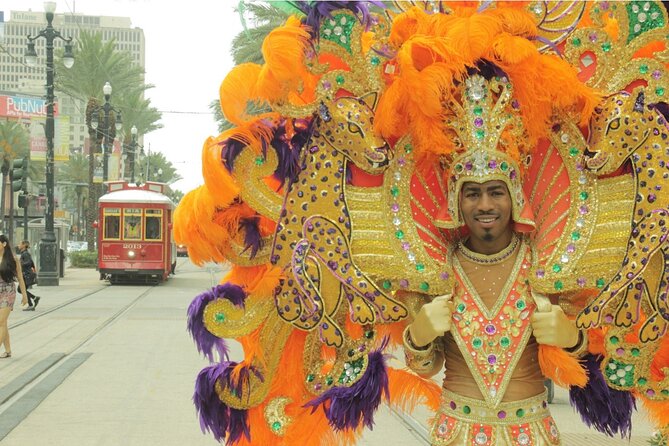
Stop 5 is the Mardi Gras Museum of Costumes and Culture, and this is where the tour shifts gears. Time on this stop is about 20 minutes, and admission is included.
The museum is described as a contemporary celebration of grassroots Mardi Gras traditions. Instead of only seeing pageantry as something imported or staged for tourists, you get a chance to view costumes and culture as something created by local people with creativity and grit.
This is a smart move at the end of a walking tour. Your legs get a rest, and your brain gets a fresh kind of context. Even if you are not a “costume person,” this can be a useful bridge from neighborhood story to cultural practice, because Mardi Gras is not just one parade, it is a system of traditions.
Practical note: since admission is included here, it helps with value. You do not have to figure out an extra ticket cost right at the end.
Price and Value: $15 for a Private Local Story
At $15 per person, this is one of those prices that feels almost too friendly for a private guided experience. The math gets even better when you consider that the Mardi Gras Museum admission is included, and one of the other stops (the medical center/Charity Hospital related stop) is free.
You should still budget for optional spending:
- Backatown Coffee Parlour does not include admission, so if you want a drink or snack, you pay that separately.
- The Storyville District stop does not list admission included, which usually means you are not buying a ticket for the walking component.
But overall, the value comes from the structure: you are paying to get a guided interpretation of the neighborhood’s key themes, plus the photo help, without spending all day.
If you have a tight schedule in New Orleans and you want one experience that is both focused and meaningful, $15 for a private format is hard to beat.
What to Bring for Better Photos and a Smoother Walk
Because the tour includes photo assistance, you should set yourself up to use it well.
Bring:
- A phone or camera with enough battery life for an hour or two
- Comfortable walking shoes, since you are moving between multiple short stops
- A light layer if weather swings, and a rain plan if conditions look questionable
Also, come with at least one goal for your pictures. For example, you might want street-level shots, portraits with the neighborhood behind you, or documentary-style images that tell a story. When you tell the guide what you are after, the photo help tends to land better.
And if you care about good photos, pay attention to the guide’s cues about where to stand and when to shoot. That is the main service you are buying here, and it is worth using.
Who This Tour Fits Best
This is a good match if you:
- Want to escape the tourist trail without sacrificing context
- Like a short, guided route that connects history, policy, and neighborhood change
- Want a factual account with an African American perspective
- Care about taking better photos, not just sightseeing from a distance
It is also a strong choice for couples or solo travelers who want a private experience without feeling like you are spending a fortune. Since it is offered in English and most people can participate, it is a practical add-on to most New Orleans itineraries.
If you prefer only famous monuments and big landmarks, this may not scratch that itch. The focus here is neighborhood meaning, not postcard spectacle.
Should You Book This Tremé Walking Tour?
I think you should book it if you want one short New Orleans experience that feels authentic and guided, with personal attention. The standout value is the private format, Hollis’s approach to local storytelling, and the practical photo help. Add in that the Mardi Gras Museum stop includes admission, and the cost feels fair.
I would hesitate only if your main priority is a long, slow museum-style day, or if you have no flexibility for weather. The tour depends on good conditions and is built around walking between stops.
If you like your New Orleans less curated and more lived-in, this one is a solid bet.
FAQ
How long is the Tremé Walking Tour?
It runs about 1 hour to 1 hour 30 minutes.
What does the tour cost?
The price is $15.00 per person.
Is this tour private or shared?
This is a private tour/activity, so only your group participates.
Where do you meet, and where does the tour end?
You start at 301 Basin St #1, New Orleans, LA 70112, USA, and the tour ends at 1010 Conti St, New Orleans, LA 70112, USA.
What language is the tour offered in?
The tour is offered in English.
Are tickets included for all stops?
No. Mardi Gras Museum admission is included. Backatown Coffee Parlour and the Storyville District are listed with admission not included. The medical center stop is listed as free.
What if the weather is poor?
This experience requires good weather. If it is canceled due to poor weather, you will be offered a different date or a full refund.
Can I get a refund if I cancel?
No. This experience is non-refundable and cannot be changed for any reason, so the amount you paid will not be refunded if you cancel or request an amendment.
More Tours in New Orleans



More Tour Reviews in New Orleans


More Treme & Marigny Tours


More ways into New Orleans


Walking Tours, compared.
 ★ 4.5New Orleans Premier Ghost, Voodoo and Vampire Walking TourFrom $2712,856 reviews
 ★ 5.0New Orleans Food Walking Tour of the French Quarter with Small-Group OptionFrom $756,118 reviews
 ★ 4.5St. Louis Cemetery No. 1 Official Walking TourFrom $253,941 reviews
 ★ 4.5New Orleans French Quarter, Voodoo and Culture Walking TourFrom $272,961 reviews
 ★ 5.0New Orleans Garden District History Walking TourFrom $352,879 reviews
 ★ 4.5New Orleans Haunted Ghost, Voodoo & Vampire Walking TourFrom $322,731 reviews
 ★ 5.0French Quarter Historical Sights and Stories Walking TourFrom $352,724 reviews
 ★ 4.5Ghost and Vampire Walking Tour Of The French QuarterFrom $212,406 reviews
Browse the lists this tour appears in