

REVIEW · WALKING TOURS
Walking the Tremé: A Self-guided Audio Tour of New Orleans
Tremé reveals New Orleans one block at a time. This self-guided audio walk uses location-triggered storytelling to connect street corners with real people, real art, and the kind of history you can’t get from a bus window.
Two things I like a lot are the GPS-guided audio that helps you stay oriented, and the lineup of stops that includes Backstreet Cultural Museum, plus major cultural landmarks tied to Mahalia Jackson and Louis Armstrong.
One thing to consider: because it’s app-based, you may want to plan for the chance of a slow start or app freeze at the beginning, just as you would with any downloadable audio tour.
Key highlights worth your attention

- Location-triggered narration so the story can start when you reach each spot
- Backstreet Cultural Museum visuals like Mardi Gras Indian costumes and second line umbrellas
- African American Museum grounds with Tremé Villa Meilleur connections and local building styles
- Mahalia Jackson Theater stop focused on gospel, roots, and stage presence
- Louis Armstrong Park angle with Satchmo context right where he was born nearby
- Offline access in VoiceMap for audio, maps, and geodata, so you are not stuck with signal
Walking the Tremé with VoiceMap: a neighborhood you can actually follow

Tremé is the kind of place where the details matter. A self-guided audio tour works well here because you can pause when something catches your eye, then pick up the story when you’re ready. At $9.99 per person, it’s also one of the easier ways to slow down and understand what you are seeing without adding extra tours to your day.
What makes this format feel smart is the GPS detection. Instead of listening to a single long track, the narration is designed to respond to where you’re standing. That matters in a walking neighborhood like Tremé, where you might miss a turn or wander 2 blocks, and suddenly the story no longer fits what’s in front of you.
The route is also paced for a short outing. The tour is listed at about 1 hour, so you can fit it between other plans without burning a half-day.
More music and neighbourhood history in Treme and Marigny


Where you start and how the walk finishes at Saint Augustine
Your starting point is 801 N Rampart St, New Orleans, LA 70116, and the tour ends at Saint Augustine Catholic Church, 1210 Governor Nicholls St, New Orleans, LA 70116. On paper, that makes it simple: you get dropped into the neighborhood at one end, and you walk toward the church area where the narrative closes.
A practical tip: plan your phone setup before you reach the first stop. The tour includes a VoiceMap app experience with offline support, but the experience depends on the audio being ready at the start location. If you ever hit a frozen download screen, one helpful step is reaching out to [email protected] with your redemption details.
The tour’s hours are listed as open 12:00 AM to 11:59 PM. In plain terms, the audio program is available anytime, but museums and theaters may have their own hours once you arrive. Build in time to look first, then listen, and don’t assume every building will be accessible at all times.
Stop 1 at Saint Augustine: the War of the Pews in 1842
The story begins at Saint Augustine’s Church, with a dramatic neighborhood-era conflict that helps you understand how power played out through everyday worship. In 1842, Creoles of color began purchasing pews inside the church for family Sunday worship. Then, according to the tour narrative, white people launched a campaign to buy family pews too. That conflict is described as the War of the Pews.
Why this stop works as an opening: it gives you a framework for reading Tremé. You start to notice that this is not just folklore or pretty architecture. It is also a record of who had access, who was excluded, and how community life collided with control.
What to watch for as you listen: take the time to look at the church setting itself. The audio focuses on the pew story, but you’ll get more meaning if you connect it to the actual place where worship happened, not just the facts.
A small practical note: since this is a real church site, behave accordingly. Keep your voice down, and treat it like a living religious space, not a museum hallway.
Backstreet Cultural Museum: Mardi Gras Indian costumes and second line umbrellas
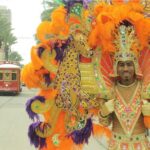
This is one of the most visually rewarding parts of the walk. The tour points you to the Backstreet Cultural Museum, where you can see an incredible collection of Mardi Gras Indian costumes, plus second line umbrellas and historic photographs connected to the backstreets of New Orleans.
Even if you only catch a slice of what’s inside, the emphasis makes sense. Mardi Gras Indian culture is not just decoration. It is community memory, artistry, and identity carried forward through preparation, craftsmanship, and performance. Seeing costumes and umbrellas in context helps you understand why the neighborhood’s creativity is not an add-on. It’s part of how people survived, celebrated, and claimed space.
What I like about including this stop in the same audio walk as gospel theaters and jazz parks is the balance. You get more than one kind of culture story. You get performance culture, religious culture, and music culture moving through the same streets.
Possible consideration: if you are short on time, prioritize looking at the costume details and the photographs first. The audio story will give you direction, but your eyes do the real work.
New Orleans African American Museum grounds and Tremé Villa Meilleur

Next you move into the New Orleans African American Museum grounds, where the setting is shaded and the focus is on people and places. The narrative highlights Tremé Villa Meilleur’s original kitchen dependencies, along with homes that reflect a range of local building styles.
This is a great stop if you enjoy the “how did people actually live” side of history. Tremé is often discussed in broad terms, but these kinds of site details bring you closer to daily reality. Kitchen dependencies are not glamorous, but they tell you where work happened and how homes were arranged for family life and labor.
Also, the inclusion of building-style variety is a subtle gift. It reminds you that neighborhoods are never one-size-fits-all. Even when people share a geographic space, they build and adapt in different ways based on resources, tradition, and change over time.
If you’re the type who likes to take it slow, this section is ideal. You can pause and absorb. If you prefer a tight schedule, treat this stop as your “look and listen” anchor, then keep moving.
You can also read our reviews of more walking tours in New Orleans






Mahalia Jackson Theater: gospel roots that never left New Orleans

From the museum grounds, the audio turns to music and faith with a stop at the Mahalia Jackson Theater of the Performing Arts. The tour narrative connects her rise to a key moment in gospel history: she cut one of the highest-selling gospel songs in history, then stepped onto the international stage. The story also emphasizes that she never forgot her New Orleans roots.
This matters because Mahalia Jackson is not only a name on a plaque. She is a bridge between church sound and worldwide audiences. Hearing the story while you are near the theater gives you a reason to pay attention to the building and its role in performance culture, not just the fact that she is famous.
What to do here: listen to the gospel roots angle, then look at the theater as a continuation of that legacy. It helps the story land, especially if you are more familiar with jazz and street culture than with gospel’s major influence.
Louis Armstrong Park: Satchmo and the Tremé neighborhood story

The final major cultural landmark in the route is Louis Armstrong Park. The tour reminds you that Armstrong, affectionately nicknamed Satchmo and Pops, was born in 1901 just outside Tremé. It also describes his early life among churchgoers, hustlers, pimps, and musicians.
That mix is the point. Tremé, in this story, is not sanitized. It’s a real community made of community strengths and community pressures. Armstrong’s upbringing is framed as something that grew from the neighborhood’s full range of characters, not just its talent.
If you want a quick way to connect the dots, listen to the portion about his nicknames and birthplace, then look around the park area. You are basically walking from the idea of church belonging, to neighborhood artistry, to musical superstardom. The audio makes that progression feel purposeful.
How long it takes, and how to pace your listening

The tour is listed at about 1 hour, which is a workable length for three reasons. First, it is self-guided, so you control your speed. Second, the GPS prompting helps you avoid long dead zones where you wander without audio. Third, the stop list is focused, not sprawling.
My practical advice: treat the walk as a series of short listening moments, not a single podcast marathon. When you arrive at each location, pause and listen first, then look. When you finish a stop, don’t immediately rush. Take 2 minutes to absorb what the story pointed you to.
Also, consider footwear. This is a walking neighborhood tour. If you wear stiff shoes or spend your day on heels, you’ll notice it faster than you expect.
Value for $9.99: why this is more than a cheap way to pass time
At $9.99 per person, the value comes from what is included, not just the price tag. You get:
- Lifetime access to the Walking the Tremé tour
- The VoiceMap application
- Offline access to audio, maps, and geodata
- Directions to the starting point, so you can find the launch spot
- Flexibility to explore at your own pace with a self-guided GPS walk
That lifetime access piece is underrated. If you come back to New Orleans later, or you want to repeat the walk with fresh eyes, you can. And because the app supports offline audio and maps, the experience is more reliable than tours that depend entirely on cell service.
What is not included is also clear: smartphone, transportation, and food or drinks. Admission fees for any stops not covered by the tour are your responsibility.
So the real equation is simple. If you want cultural context for the cost of a casual meal, and you like walking with a story, this is a strong deal.
A couple of real-world cautions from experience-style issues
This is where I help you plan like a grown-up, not like a hopeful tourist.
1) App startup can be the weak link. One issue reported is the tour not playing at the start location due to the tour being stuck on a download page. If that happens, don’t spend your whole trip wrestling with your phone. Step away, re-check the app state, and use the support contact route if needed.
2) Watch street-crossing routes closely. One part of the route asks you to cross a road described as not made for pedestrian crossing. That means you should slow down and be extra careful. Use crosswalks where available, and don’t trust the GPS to replace your eyes.
The bright side: when it works, this tour experience is the kind that leaves you feeling like you understand what you just walked through, not just that you walked through it.
Who this Tremé audio walk suits best
You’ll likely like this tour if you want:
- A short, focused walk instead of a long guided day
- A way to connect Tremé sites with music, gospel, and neighborhood art
- GPS-driven storytelling that helps you follow along
- Offline audio and maps, useful in neighborhoods where reception can vary
It may not be your best fit if you hate apps, get frustrated by downloads, or would rather rely entirely on live human guidance. But if you’re comfortable with a phone-based self-guided experience, this is a smart way to explore.
Should you book Walking the Tremé with VoiceMap?
I’d book it if you want a cost-effective Tremé intro that blends street-level history with major cultural figures. The story flow is strong: church conflict, neighborhood artistry, museum grounds tied to local life, Mahalia Jackson’s gospel legacy, then Louis Armstrong Park with roots in and around Tremé.
I would skip it or approach with extra patience if you are unlikely to troubleshoot an app-based tour, or if you feel uncomfortable around complicated road crossings. In that case, you might prefer a live guide who can handle timing and street logistics for you.
If your goal is to walk the neighborhood with meaning, for about an hour, this hits the sweet spot.
FAQ
How much does the Walking the Tremé audio tour cost?
It costs $9.99 per person.
How long is the tour?
The tour is listed as about 1 hour.
What language is the tour available in?
The tour is offered in English.
Is offline access included?
Yes. You get offline access to audio, maps, and geodata through the VoiceMap application.
Where does the tour start and end?
It starts at 801 N Rampart St, New Orleans, LA 70116, and ends at Saint Augustine Catholic Church, 1210 Governor Nicholls St, New Orleans, LA 70116.
Do I need to bring a smartphone?
Yes. A smartphone is not included.
Are service animals allowed?
Yes, service animals are allowed.
Is this tour limited to a certain group size?
Yes. The tour has a maximum of 10 travelers.
What is the cancellation policy?
You can cancel for free up to 24 hours in advance for a full refund. If you cancel within 24 hours of the experience start time, there is no refund.
More Tours in New Orleans



More Tour Reviews in New Orleans


More Treme & Marigny Tours


More ways into New Orleans


Walking Tours, compared.
 ★ 4.5New Orleans Premier Ghost, Voodoo and Vampire Walking TourFrom $2712,856 reviews
 ★ 5.0New Orleans Food Walking Tour of the French Quarter with Small-Group OptionFrom $756,118 reviews
 ★ 4.5St. Louis Cemetery No. 1 Official Walking TourFrom $253,941 reviews
 ★ 4.5New Orleans French Quarter, Voodoo and Culture Walking TourFrom $272,961 reviews
 ★ 5.0New Orleans Garden District History Walking TourFrom $352,879 reviews
 ★ 4.5New Orleans Haunted Ghost, Voodoo & Vampire Walking TourFrom $322,731 reviews
 ★ 5.0French Quarter Historical Sights and Stories Walking TourFrom $352,724 reviews
 ★ 4.5Ghost and Vampire Walking Tour Of The French QuarterFrom $212,406 reviews
Browse the lists this tour appears in