

REVIEW · GARDEN DISTRICT TOURS
Self Guided Walking Tour of New Orleans’ Historic Garden District
If you like architecture and stories, this is for you. A self-guided walk through the Garden District, it turns a simple stroll into a guided experience on your schedule.
I love the lifetime access and the offline VoiceMap setup, so you can download once and keep going without stressing over signal. I also like how the narration feels timed to where you are, which makes it easy to follow even if you stop often.
One drawback to plan for is uneven pavement in places, so wear supportive shoes if you have balance or mobility issues.
Key highlights worth planning around

- Off-the-grid flexibility with offline audio, maps, and geodata through the VoiceMap app
- Self-paced narration that you can pause and continue without keeping up with a group
- House lore with movie tie-ins, including Django Unchained and American Horror Story
- Real architectural variety, from Greek Revival details to large pre-Civil War mansions
- A strong ending at Lafayette Cemetery No. 1, giving your walk a clear finish line
Why this Garden District audio walk feels like good value

For $7.49 per person, you are buying more than a short tour. You get lifetime access in English, plus the VoiceMap app with offline audio and maps. That means you can use it on this trip, then repeat the route later when you want another look at the architecture or when you have guests who love old neighborhoods.
The biggest practical win is control. Instead of syncing to a guide’s pace, you set the rhythm. If you want to stand in front of a house longer to study the details, you can. If you need a quick break, you can. That matters in New Orleans, where the weather and your own energy can change fast.
The tour is designed for a walk that usually takes around 1 hour to 1 hour 15 minutes, so it fits neatly into a day that also includes other Garden District stops or nearby neighborhoods. And since it is private, only your group does the walking, which keeps the whole thing calmer than a stranger-heavy group tour.
More Garden District stories among the live oaks


Starting at Rink Shopping Center and finding the Garden District vibe fast
You begin outside the Rink Shopping Center at 2727 Prytania St. Your first visual anchor is the Garden District sign, which helps you lock in where you are before the audio starts pulling you forward.
From there, the tour works like a series of small reveals. You will move down picturesque streets, and the narration cues you at the points that matter most. A key benefit of the app format is that it helps you avoid the common self-guided problem: wandering around wondering if you are at the right house.
This is also a good time to make sure your phone is ready. The audio is your guide, so headphones and a charged phone can make the difference between smooth and stressful. (Headphones are not included, so bring your own.)
Briggs-Staub House and Opera Guild Home, your first big architectural lesson

Early on, you catch a glimpse of the Briggs-Staub House. It is not a formal stop, but it sets the tone. You start noticing the Garden District look: elegant facades, historic proportions, and the way these streets are laid out for slow, curious walking.
Next comes the New Orleans Opera Guild Home, which is a real architecture moment. The tour highlights its 1850 Greek Revival double gallery, and this is where you start seeing how style becomes story. Greek Revival in New Orleans often means strong symmetry, classic lines, and features meant to look formal and sturdy, even as neighborhoods evolved around them.
The audio also connects the building to its pop-culture footprint. If you recognize it from Django Unchained, you get that fun extra layer: you are not just looking at a pretty old structure, you are looking at a set piece that became part of modern memory.
McGehee School, Buckner Mansion, and the lore you will remember

As you continue, you pass the Louise S McGehee School. It is another pass-by point rather than a long pause, but it adds texture. You are not only tracking grand homes here. You are also seeing the educational institutions that shaped day-to-day community life in the neighborhood.
Then you reach Buckner Mansion, described as the largest house built before the Civil War. That scale is the point. When you approach a place like this, you feel how power and money were expressed in architecture, not just in speeches or politics. The house gives you a sense of why the Garden District became known for elegant residences and why these streets still draw people who care about design.
There is also a modern storytelling hook. The mansion has appeared in American Horror Story, and the audio uses that connection to keep the history approachable. It is a useful reminder that old buildings do not only sit still. They show up again and again in new ways.
The Seven Sisters myth and Pritchard-Pigot style check

You will then pass the Seven Sisters houses. The audio does something clever here: it tackles a common myth. The story you might hear elsewhere is that a father built them so his seven daughters could live side-by-side. The tour presents this as lore you can question, not a settled fact you must accept.
Why this matters: it teaches you to look at history with a little skepticism and curiosity. The Garden District is full of buildings that people love to tell stories about. Learning which tales hold up, and which are more legend than fact, makes your walk more interesting.
After that, you pause at the Pritchard-Pigot House. It can resemble a fraternity-style building, according to the tour’s framing, which makes it easier to register quickly when you are walking by. The audio uses the look to guide you into the architectural details you might otherwise miss when you are just passing street-level sights.
You can also read our reviews of more walking tours in New Orleans






Carroll-Crawford House and Warwick Manor, two ways to read the same neighborhood

Next you get a sequence of elegant residences that blend into the Garden District streetscape, including the Carroll-Crawford House and Warwick Manor. These stops are described as pass-by moments, so you are not expected to linger for a long time at each one.
Still, they are useful because they help you notice patterns. You can compare facades. You can compare layout impressions. And you can start building your own map of what makes the Garden District feel cohesive even when the buildings vary.
This is where the self-guided format helps most. If you notice something you like, you can slow down. If a house is not grabbing your attention, you can keep moving. That control keeps the experience enjoyable, instead of turning it into a checklist you have to complete.
Camp and Third Street plus the Montgomery-Hero Railroad connection

At one point, you pass the corner of Camp and Third Street. Even though it is not a major stop, it matters for orientation. Street corners in the Garden District help explain how the neighborhood is navigated, and the audio framing helps you understand the layout instead of treating it like random streets.
Then comes Montgomery-Hero House, which the tour presents with a specific historical angle. The house was constructed for Archibald Montgomery, identified here as president of the Crescent City Railroad. That detail pulls you out of pure architectural admiration and into how people, jobs, and transportation shaped where wealth settled.
Railroad power was real power in the 19th century. Connecting that to a specific house makes the story feel grounded. Instead of history floating in theory, you connect it to a building you can stand in front of.
Walter Grinnan Robinson House, the indoor plumbing moment

The tour then points you toward the Walter Grinnan Robinson House, calling it the first home in the area to feature indoor plumbing. That might sound like a small detail, but it is actually one of the most practical pieces of history you can learn on a walking tour.
You start thinking about daily life. Indoor plumbing changes routines, sanitation, and how a home functions. Instead of just appreciating ornament and symmetry, you get a peek into what was technologically new at the time and what would have made a home feel modern and luxurious.
If you like history with cause and effect, this stop is a highlight. It shows you how comfort and convenience are not just modern concepts. They were big deals even back then.
Commander’s Palace by the route, and how to use the ending wisely
Near the end, you pass Commander’s Palace. It is not a stop in the sense of an extended listening pause, but it is a useful waypoint. It reminds you that this neighborhood is not only preserved for viewing. It is also lived in, visited, and celebrated through institutions that still operate today.
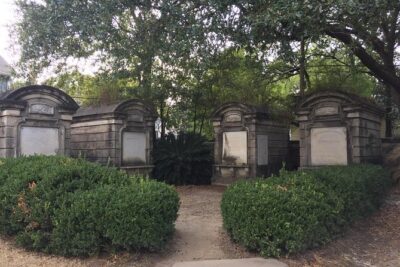
After that, the tour sets you up for a reflective finale outside Lafayette Cemetery No. 1. The ending at 1427 Washington Ave gives you closure. You stop, look around, and connect the cemetery setting to the neighborhood you just walked through.
Cemeteries can feel abrupt at the end of tours, but here it works because you already learned to look carefully at places where people lived. Now you get the chance to look at a place where people are remembered, which makes your walk feel more complete.
Practical tips so you enjoy every minute of the walk
If you want this to feel smooth, a few details make a difference:
- Bring headphones. The tour relies on audio, and the listing does not include them.
- Use your phone like a tool, not a distraction. Keep it ready for the app cues so you do not miss prompts.
- Expect to adjust for walking comfort. Uneven pavement is mentioned as a consideration, so pace yourself and use careful footing.
- Plan your weather window. You will be outside for an hour or so, and New Orleans heat and humidity can change how long you want to linger at each house.
One more helpful note: even though the tour is built for walking, some people prefer to go at it in their own way, like walking portions and driving between points. If you do that, street direction and route planning can matter, so be ready to adjust.
Who this self-guided Garden District walk is best for
This is a strong match for you if you want:
- Architecture-focused sightseeing without paying for a full guided tour
- A flexible schedule where you can pause and restart without feeling rushed
- A story-led route that adds meaning to the buildings, not just names and locations
- A calmer experience if group tours are stressful, because you control the pace
It also works well for couples. The format stays intimate, and the app makes navigation feel less like a scavenger hunt.
If you are traveling with limited mobility, do not assume every surface is even. You can still enjoy it, but choose supportive footwear and move slowly where the ground feels rough.
Should you book this self-guided Garden District walk?
Yes, I think you should book it if you want an easy, low-cost way to understand the Garden District in about an hour to 75 minutes, at your own pace. The big reason is value: lifetime access plus offline audio and maps for a one-time low price. Add in the clearly defined route starting near Prytania and ending outside Lafayette Cemetery No. 1, and you have a satisfying arc.
I would hesitate only if uneven pavement would be a serious problem for you. If your mobility needs more even surfaces, you might prefer a different format. But if you can handle a little sidewalk texture and you like meaningful architecture stories, this one is a smart buy.
FAQ
How much does the self-guided Garden District walking tour cost?
It costs $7.49 per person.
How long is the tour?
The walk takes about 1 hour to 1 hour 15 minutes.
What language is the audio available in?
The tour audio is offered in English.
Where does the tour start?
The tour starts outside the Rink Shopping Center at 2727 Prytania St, New Orleans, LA 70130.
Where does the tour end?
The tour ends outside Lafayette Cemetery No. 1 at 1427 Washington Ave, New Orleans, LA 70130.
What do I need to use the tour?
You need a smartphone and headphones, since they are not included.
What is included with the purchase?
You get lifetime access to the tour in English, the VoiceMap app for Android and iOS, and offline access to audio, maps, and geodata.
What is not included?
Smartphone and headphones are not included, and transportation and food and drink are also not included.
What are the tour hours?
For the listed operating dates (01/26/2024 to 02/16/2027), it runs Monday through Sunday from 12:00 AM to 11:59 PM.
Is the tour private?
Yes. Only your group will participate. Service animals are allowed, and it is near public transportation.
More Tours in New Orleans



More Tour Reviews in New Orleans


More Garden District Tours



More ways into New Orleans


Garden District Tours, compared.
 ★ 5.0New Orleans Garden District History Walking TourFrom $352,879 reviews
 ★ 4.5New Orleans City Tour: French Quarter, Garden District & CemeteryFrom $402,209 reviews
 ★ 5.0New Orleans Small-Group Garden District Walking TourFrom $351,384 reviews
 ★ 4.5New Orleans City and Cemetery Tour with Garden District StrollFrom $55766 reviews
 ★ 4.9Garden District Guided Walking TourFrom $35514 reviews
 ★ 5.0New Orleans Highlights of the Garden District Walking TourFrom $37492 reviews
 ★ 4.8Garden District TourFrom $28480 reviews
 ★ 5.0Garden District Home and History Walking TourFrom $26470 reviews
Browse the lists this tour appears in